

So what the heck does dog training have to do with health and wellness? If you’ve ever had a misbehaving pup, you know how it drives you nuts and the stress and anxiety is enough to wreak havage (havage = havoc and ravage) on your immune system. [Me loves portmanteau words.]
First off, it’s been over 30 years since I trained dogs professionally, and if you go searching on YouTube you’ll find some “kids” doing amazing things with pups. The biz has really changed in the past 30 years, and I really recommend you take a look.
These little tips that I’m going to show you still work, and work well.
Keys
Find some old keys and a key chain. Make sure they jingle loudly when you shake them. Now tie a loudly colored ribbon to them. Why? You’re going to toss them, and after you’ve tossed them, you’re going to want to find them. The ribbon really helps.
So you’ve got a new pup and like all new pups, they don’t quite know their boundaries. You can give them safe toys to chew (all pups chew) but when you turn your back, they’ll start chewing on your shoes, your handbag, the furniture, and whatnot.
The trick is to keep an eye on the pup when it’s free (kenneling a pup is not torture, but keeps your pup safe; I’ve heard far too many horror stories about pups chewing electrical wires).
The moment the pup picks out something to chew that you don’t want it to chew, toss the keys lightly at it’s butt.
The toss is not supposed to hurt, but to startle.
And remember, every time the pup stops the “bad behavior” you must reward it with petting, perhaps a treat (not too many treats now), and lots of words of encouragement.
When to use the keys? When the pup squats to pee in the house, lifts a leg, jumps up on a stranger, is in the garbage, scratches at the door to go out, or doesn’t stop barking at a family member. In that last situation, holding your finger to your mouth and saying “shhhhh” is seen as a positive reinforcement. A pup’s first language is body language. The finger to the mouth is now a gesture the dog will quickly pick up. Later, after the pup is scolded and realizes it’s done wrong, just a simple “good puppy” or “good girl” or “good boy” is enough positive reinforcement.
Remember: you are the pup’s life. It’s survival, it’s love, it’s protection. It will always look up to you and love you unconditionally.
The best thing about using the keys is how quickly the pup learns from them. In the first book I read it said I might have to use the keys 10 times or more, but I’ve found that after three or four times, the pup learns and watches me intently.
No More Tossing
It won’t take long, but soon, the moment the pup does something wrong, all you have to do is shake the keys and it will perk up and you can immediately reward it with pets and praise.
If you don’t have the keys with you, you can always jingle the change is your pocket or change purse. That will elicit the same behavior.
When the Pup Won’t Come
This is the one question pet owners have constantly asked me: “What do I do when the dog won’t come to me.”
Keep in mind that to train a dog you have to be smarter than the dog.
Next, how did you train the dog to come in the first place?
I’m never amazed anymore when I learn that the owners never trained their dog to come.
Sit, stay, come are FREAKING BASIC!
Teaching a Pup to Come
There are so many ways but let’s start with the most basic. Your pup loves you and wants to be near you, so bending over (this teaches the pup not to jump up) and slapping your thighs in front while calling “Here puppy, here puppy!” is most often all that’s needed. Once you’ve gotten that down, toss in the word, “Come” and later, a whistle.
If the pup you’ve gotten is an older, untrained pup, it’s going to be a bit more difficult. Offering a treat is okay, but like I said, not too often. You won’t have treats all the time, and it can turn into a problem that too many humans have when treats are associated with love.
I have a 30 foot leash that I sometimes use, and when you slap your thighs and call, you can easily pull the pup toward you.
So now the problem of getting the dog to come is only a problem after it’s been trained to come, and simply decides not to come.
Every animal will eventually assert its will. Some say their testing their boundaries. Some say they’re just stubborn. Personally, I neither care nor know why, I just know that the pup has to learn to come when called.
And here is where the keys come in.
You take them out, and shake them (get its attention). Then toss them to your side, 90 degrees from the line between you and the pup.
The pup will come to you.
I have never seen this fail.
Also, teach the pup to sit before you after it comes.
[I had a pup give birth to a litter of 9 and I posted an ad in the paper, selling them. When people came to see them, they were hiding under my porch. I called to them and they all game running out, and sat down in a line in front of me. Yup, people were amazed, but training is all about starting early and being consistent.]
If you don’t know how to teach a dog to sit, please pick up a book on the basics of training. Sit, stay, lie down, sit up, and come are truly basic things a dog must learn or you’re just not going to get along with each other. And besides, coming is basic to survival. One advanced move that can also save your pup’s life in yelling out to it lie down (with a huge hand signal) while it’s running to you. You never know when a damn car is going to pull out and not see the pup.
A trained dog is a happy dog and a healthy dog that will live a long life.
How to Keep Your Pup Out of the Garbage
This can also be used to keep the pup from scratching at a door.
You go out and buy a pack of balloons. Nice sized round balloons.
While the pup is near its kennel (every dog needs a section of the house called “kennel” even if there is no kennel there; it’s their safe spot where no one may harm them, and it’s also the place you send them when they’ve been misbehaving or rolling in the mud), in its line of sight, start blowing up the balloon. Have a pin ready in one hand. Motion to the dog to come over. They’re curious. They want/need to know what that darn thing is. The moment it touches its nose to the balloon, pop it.
You only have to do this twice (maybe a third time) and they will learn not to go near balloons. Then put them in your trash cans. It the pup scratches at the door, hang a few from the door handle. If you want to keep it out of your shoe closet, lay a few on the floor.
Chewing on Wires
This is something you MUST stop and stop fast. Go get some hot sauce. Some very hot sauce and paint it on wires the pup can get at. It’s that simple. Paint it on everything the pup wants to chew on that it’s not allowed to chew on, and make sure your pup has plenty of things it can chew on. Bully sticks and things that are digestible are the best. Indestructible toys are great too, though in my experience, for some pups there’s no such thing as an indestructible toy.
One time I didn’t use the hottest sauce I could find, and later learned my pup really loved spicy Mexican food.
Teaching Your Pup to Poop in a Particular Spot
I don’t know if I’m such a great dog trainer or I’ve just had really intelligent pups, but I’ve been told by veterinarians that you can’t teach a pup to pee on command.
Yet all my pups eventually learn to pee on command. Just repetition and praise, it seems.
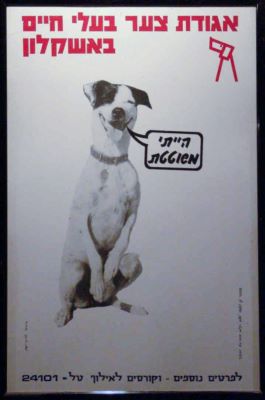
In fact, one time we took Vivis (she was the most famous dog in Israel) on tour and we all stopped to stretch. The tour was to build support for Humane Societies [image on the right] and my favorite vet from Jerusalem came along on the trip. At one stop, I told Vivis to go pee pee. He looked at me and told me I couldn’t train a dog to do that. Sure enough, Vivis went a little distance from the bus, squatted, peed, and then scratched at the ground (as dogs sometimes do). He was amazed.
At our next stop (another break to get out and stretch), I told the vet, “Now watch this.”
Vivis didn’t have to go, but I told her anyway to “Go peepee.”
She went over to a nice spot, prepared to squat, and then quickly looked off to the East.
We both looked off to the East.
When we looked back, with a big smile on her face, she was scratching at the ground telling us she’d finished.
It was very difficult to be smarter than that pup.
We were living in an apartment complex and residents played and gathered and sat and used the grass; I didn’t want Vivis pooping on the grass. I wanted her to poop in the bushes off to the side of the complex.
Here is what I did.
I got a match book. I took her to where I wanted her to do her business, licked the end of the match (not the phosphorous end), lifted her tail, and inserted the match into her anus.
The only way a dog can get it out is to poop it out. It must be pretty uncomfortable, because she did it quickly each time. After a while, I never had to do it again, because that’s where she did her business.
What Inspired Me to Write This
I’m raising a pup. The last pup I’ll raise in this lifetime. And he’s a little bastard, at times. At a year and a half old, he still has WAY too much puppy in him.
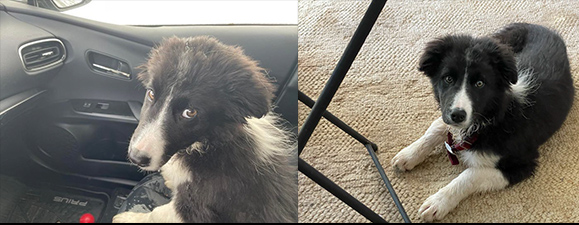
I have another rescue, named Coco that has PTSD. Every time they go down stairs to go out, Bumbus, the new pup, is in Coco’s face, nipping and teasing and it just drives Coco nuts. I can yell all I want at Bumbus, but he just keeps it up. One day I thought to myself, “The electric collar.” He wears one for the invisible fence, I guess I could—then it hit me. The keys. They were up on the edge of my kitchen. I went and got them and as they were running down the stairs, Bumbus turned to nibble on Coco’s face and I shook them. It’s been over a year since I last used the keys, but Bumbus had not forgotten. He looked up at me, knew I was not happy, and ran to the door, leaving Coco alone. In just a few more days, that mistreatment of Coco is going to stop permanently . . . or util Bumbus figures out that I no longer am carrying the keys. He’s a smart one. Too smart I think. When the invisible fence broke down and a new one was on order, I looked out and spotted Bumbus slowly creeping toward the boundary, testing the fence. What a dog!


