Twitter is being destroyed (undermined) by its spoiled rich owner, but I’ve still found lots of mentors there. This entire article has been lifted directly off of Twitter, and I’m unable to reference the author’s name since the account belongs to: Historic Vids. I have, however, checked the facts and found them to be “right on.”
Robert Liston (1794-1847) was a Scottish surgeon known for his incredible speed in surgery. His most famous operation involved amputating a patient’s leg in under 2.5 minutes. He worked so swiftly that he accidentally amputated the fingers of his assistant and even slashed a spectator’s coat tails. The unfortunate onlooker, terrified by the sight, dropped dead. Tragically, both the patient and his assistant later died from gangrene, resulting in a recorded operation with a 300% mortality rate.
British surgeon and author Richard Gordon vividly described Liston’s unique approach to surgery: “He was six foot two, and operated in a bottle-green coat with wellington boots. He sprung across the blood-stained boards upon his swooning, sweating, strapped-down patient like a duelist, calling, ‘Time me gentlemen, time me!’ to students craning with pocket watches from the iron-railinged galleries. Everyone swore that the first flash of his knife was followed so swiftly by the rasp of saw on bone that sight and sound seemed simultaneous. To free both hands, he would clasp the bloody knife between his teeth.”
Gordon’s book, “Great Medical Disasters” (1983), highlighted other intriguing aspects of Liston’s career:
- “Removal in 4 minutes of a 45-pound scrotal tumor, whose owner had to carry it around in a wheelbarrow.”
- “Amputated the leg in 2 ½ minutes, but in his enthusiasm, removed the patient’s testicles as well.”
- “An incident where he hastily lanced what he believed was a straightforward skin abscess in a young boy’s neck. Unfortunately, it turned out to be a dangerous aneurysm of the carotid artery, resulting in the patient’s death. The artery, however, lives on in University College Hospital’s pathology museum, specimen No. 1256.”
In 1846, Liston performed the first operation using modern anesthesia in Europe. He also invented tools such as bulldog forceps and a leg splint to aid in fractures and dislocations, both of which continue to be utilized in medical practice today.
Robert Liston was certainly a fascinating and somewhat controversial figure in the history of medicine. His incredible speed and skill as a surgeon were undeniable, but his penchant for theatrics and his occasional mishaps made him a rather polarizing character.
The story of the triple-mortality operation is particularly gruesome, but it also highlights the challenges faced by surgeons in an era before anesthesia and antibiotics. Liston’s speed was often crucial in saving lives, but his hasty approach also led to some tragic mistakes.
Despite his occasionally reckless methods, Liston’s contributions to the field of surgery should not be overlooked. His inventions, such as the bulldog forceps and the leg splint, are still used today, and his pioneering use of anesthesia in Europe paved the way for safer and more effective surgical procedures.
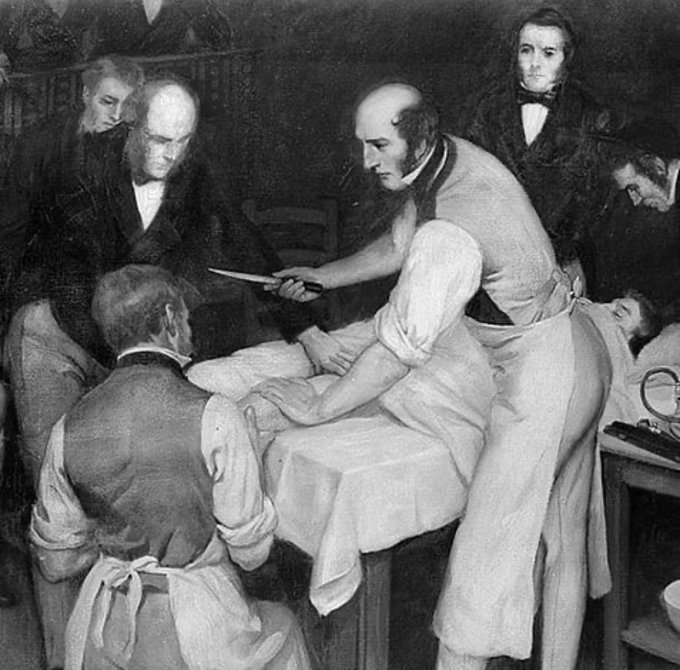
Liston’s surgical prowess was not just limited to his speed. He was also known for his innovative approach to surgery. One such instance was when he successfully removed a 45-pound tumor from a patient’s scrotum in just four minutes. This feat was not just about speed, but also about precision and skill, as the removal of such a large tumor would have required careful maneuvering to avoid damaging surrounding tissues.
In addition to his surgical skills, Liston was also an inventor. He invented several medical instruments that are still in use today. Among these were the bulldog forceps, which are used to clamp blood vessels during surgery to prevent bleeding. He also invented a leg splint, which is used to immobilize a fractured or dislocated leg. These inventions demonstrate Liston’s commitment to improving surgical outcomes and patient care.
Despite his many achievements, Liston’s career was not without controversy. One of the most infamous incidents in his career was when he accidentally cut off his assistant’s fingers during a surgery. Both the patient and the assistant later died from gangrene, and a spectator who was present during the surgery died of shock. This incident resulted in what is often referred to as the only surgery in history with a 300% mortality rate.