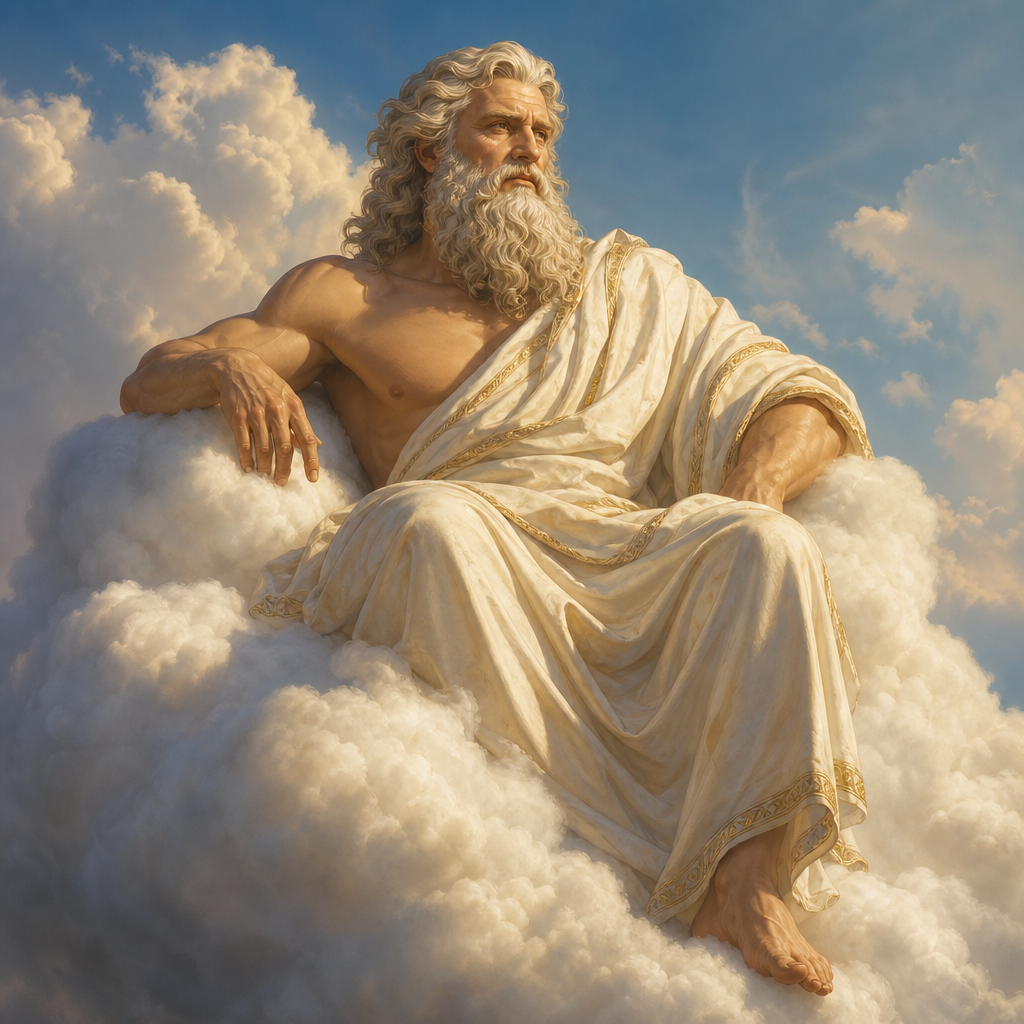

Believers believe without proof, while scientists accept off-the-wall hypotheses because of an internal consistency.
Fun Fact: Both of these are false.
A belief can be as powerful as palpable as any feeling, and for reasons that just are not scientific. I’ve always been fascinated by some Christian sects where a person or minister can “testify.” And boy do they testify! The congregations feels it and is moved by it. Humans trust these things.
Then there are the coincidences, emotions, awe, suffering and recovery, and the sheer meaning of a belief, as trusted as data.
Beliefs are transmitted, not through argument and logic, but like languages are transmitted: through immersion.
Rituals reinforce belief, communities stabilize it, and identity fuses with it. And once fused, any disagreement is an attack on that entire being.
The human cognitive architecture is predisposed toward certain kinds of explanations and interpretations. In fact, that’s why science came along in the first place: to delineate from those explanations and interpretations “what can I truly know?”
Then there’s the philosophical reasoning, oftentimes from non-religious philosophers, such as Aristotle, or Leibniz. In Catholic school I learned about St Thomas Aquinas’ “first cause” theory. He imagined the universe as a system of cogs, all well-oiled, and constantly turning. One cog turning another. But where was the first cog is all this?
All this has to have a necessary being in charge, for the sake of morality, or moral realism. It’s all teleological!
Without a God, where is meaning? Where is purpose, where is hope? Belief takes the dread out of the abyss.
Believing in God might not be logical, but it’s not random. It’s believing with a different category of proof.
Do You Believe in God?
In the early nineties, there was that chain-mail craze. You’d get an email and pass it onto friends. Many of them contained disinformation, misinformation, and urban legends; so much so that websites sprouted up to debunk all the mail in your inbox.
One particular email. I received repeatedly was the one asking: “Do you believe in God” and with instructions to pass it on because we believers have got to stick together. It was as if, we, all together, could make our god stronger.
Today, if asked, “Do you believe in God?” I respond quite simply, “Not yours.”
Instead of forwarding these, I would write back: Which one?
Now I wasn’t asking about the Greek, Roman, or Norse gods, no the Hindu or Asian gods, I was asking about our Western Gods, and I say plural in spite of Jewish, Christian, and Muslim cultures being monotheistic.
Monotheistic, but not in a really strict sense. Take the Old Testament: “You shall have no other gods before me.”
That commandment cannot be given if no other gods existed.
Then there’s Christianity, in which the father, son, and holy spirit put a twist in monotheism, or should we call it “monotheism with internal plurality?”
Now what about the saints? Angels? Demons? Yes, the Christian devil is god-like; omnipotent, omnipresent, and immortal. In this manner, Christianity behaves like a functional polytheism.”
America’s Four Gods
Again, when I was asked, and often, I responded always: “Which one.”
Sociologists Paul Froese and Christopher Bader argued that two key questions could capture the variations of how Americans perceive their God. They asked the questions, and wrote a book about the responses, called, America’s Four Gods.
You may believe in one God. But there are four variations of that one God, here in America.
- Authoritative God: active in the world and willing to judge or punish wrongdoing.
- Benevolent God: active and loving, but not focused on punis Hello how are you hment.
- Critical God: judges human behavior but does not intervene much in daily life.
- Distant God: neither highly involved nor judgmental
And there’s a fifth God, referenced by Einstein who once referred to himself as a “religious unbeliever.”
And that is Spinoza’s God.
We’ll talk about him later.
The God Particle
Now if you really want to throw a monkey wrench into the conversation about God, just mention this guy.
Everyone gets it wrong and defines it according their own needs and situation.
It really has nothing to do with “God” and got that way because the author first called it the “Goddam Particle,” because it was so damn hard to find.
Publishers had to clean it up a bit for American consumers.
Higgs Boson
This is the so-called God particle. It’s actually a tiny ripple, or excitation in the Higgs field, an invisible quantum field that fills all of space.
So if you think our discussion on God was complex, and mystically philosophical, our science discussion here will seem just as mystical, with a difference: we’re able to quantify it by testing, mathematics, and internal consistency [this is where the internal consistency fits in].
So back to our first falsity: “while scientists accept off-the-wall hypotheses because of an internal consistency.”
What scientists accept is a bit more complex and exacting than just that, so allow me (we’ll get back to the Higgs boson shortly — it’s really quite exciting) to explain.
In the beginning there was the hypothesis. It must be logical, compatible with known laws, internally consistent, testable . . . in principle, and falsifiable.
This last one is my favorite: there must be some possible observation or experiment that could show the theory wrong. Yes, scientists come up with stuff all the time that they themselves want to prove wrong, and that is one huge difference between scientists and believers. You won’t find a “believer” who wants you to prove them wrong.
An hypothesis becomes a theory only after running the gauntlet: it must be tested, with actual experiments or observations, and those results must be reproducible. A theory must be able to predict new, previously unknown outcomes, and it must explain things way beyond competing hypotheses. It cannot contradict well-established facts, unless, and this is a pretty big unless, it replaces them with something better. Other experts must try to tear it apart, and fail. And it must fit into the broader scientific picture without destroying everything else.
Look at it as a gentle bull in a china shop.
And now I shall borrow lightly from Kipling, and present a poem entitled:
To an Hypothesis
If you can keep your head when all about you
Are losing theirs, leaving the testing up to you;
If your observations make fewer doubt you,
But results can be repeated too;
If you can explain beyond competing,
And not contradict what’s known;
If you are worthy of repeating,
You’re complete and fully grown.
If your dream can burn still brighter,
And the experts’ attacks all fail,
If you stand up straighter, a fighter,
And your predictions strike the head of the nail;
If you can widen the eyes of doubts,
And turn their questions one by one,
If you hold your ground when the pressure shouts
Then you’re a theory today, my son.
In a less poetic voice: an off-the-wall hypothesis takes a beating before it is an accepted theory, or as Carl Sagan said, “Extraordinary claims require extraordinary evidence.”
Now about that boson.
So we have a field and a ripple in that field. Big deal?
Well, without that, the universe would be pure radiation: no quarks, no atoms, no chemistry, no stars, no planets, no life.
And the hypothesis was made 50 years before it was tested and became a theory.
But did it prove the existence of God.
No, at least not any of the four Gods found in the study mentioned above. The Higgs boson was just another nod to Spinoza’s God. The one Einstein believed in.
Spinoza’s God is the infinite, impersonal, lawful structure of reality itself. It is not a being who created the universe, but the universe as the only being. It is very much like the fourth God described above, the Distant God, neither highly involved nor judgmental, but one step beyond that in that the entire universe with all its rules and order is that God.
Consciousness and the Life Force
If you find it difficult for science to explain the existence of a God, it has not even come close to explaining why there is a self. Or why electrical activity can feel love, anger, hurt. Why there is meaning? And why we are aware? Science can describe consciousness. It cannot explain consciousness.
And it cannot explain how consciousness began.
To a believer, God is the answer. Consciousness is the fingerprint of God.
Matter cannot produce the mind, therefore mind must precede matter. Thus consciousness comes from a conscious source. And that is the big, bearded guy in the sky. Not a scientific answer, a metaphysical one.
To science, consciousness is the last great mystery. Or as the TV series went, “The Final Frontier.”
Of all the questions asked by human kind, here is “The Question.”
“Does consciousness continue beyond the grave?”
Science has no method to determine whether consciousness continues after death.
Back to the basics: science doesn’t know what consciousness is or where it comes from. We cannot measure subjective experience.
If consciousness is just a function of the brain, when the brain stops, consciousness stops. We can measure brain activity, but is consciousness simply brain activity? When you get knocked unconscious, there’s still brain activity.
I’m going to introduce you to one of my favorite scientists, David Bohm. He’s controversial because he’s both a scientist and philosopher, but first let’s take a look at “qi.”
Qi — The Life Force
This is something that Western science has trouble with. It was discovered 6,000 years ago, mapped the meridian system, and Eastern physicians have worked with it . . . but in the US, it’s still controversial. The ancients described patterns, flow, connections, while Western scientists have discovered, structures, networks, and fields.
When the life force is gone, the body dies. But energy doesn’t die. Where does it go?
Being a martial artist and practitioner of qigong, I am familiar with qi in ways that scientists are not. I’ve felt qi, I’ve moved people with qi alone, I’ve demonstrated it by finding an orange sitting on a table, blindfolded, and I’ve used it to knock a 400 lb bag off its hook . . . which once it had been hung, nothing had moved it off its hook and it would take three people to take it down.
And I’ve watched a qi master pile bricks up before him and ask a stranger in the audience to put an X on one of the bricks, just not the top one. And I watched the master focus his qi, bring his hand downward, landing on the top brick, but smashing only the brick marked with the X.
Western scientists have trouble with this stuff. They really do.
David Bohm (1917–1992) was a theoretical physicist who made important contributions to both quantum physics and the philosophy of science. Bohm’s view, particles have definite positions and trajectories at all times, guided by a quantum wave.
This interpretation reproduces the predictions of standard quantum mechanics but avoids the idea that particles lack definite properties before measurement.
Bohm’s particles move, but the quantum wave provides the active information that guides the particle’s movement.
Think of it this way: a ship sailing contains a lot of energy and movements. The radar signal contains very little energy, but carries the crucial information to direct the ship.
Qi is the biological version of Bohm’s informational flow. This isn’t litteral or mathematical, but conceptual.
Life: it’s not mechanical. It is a flow of energy, organized energy. A flow guided by information.
Consciousness is not produced by matter. It’s a part of the informational order that shapes matter.
At an atomic level, what we perceive as solid objects are mosly empty space.
There are no solid objects. There are only fields. Particles are excitation in those fields. Our human bodies are stable patterns in those fields. Death is the dissolution of that pattern, but not the destruction of anything fundamental.
The human soul is impossible to define, though religions have had a millennia to try. Is it consciousness? Is it Qi? It must be energy, at least. When we die, qi doesn’t die, it returns to the universal field of information and energy that it was always a part of. The pattern dissolves, but the underlying reality remains.
Bohm’s model makes this explicit. The implicate order cantains all information, the explicate world is the unfolding of that information, and when a form disolvers, it’s information re-enfolds. Nothing is lost, and everything returns to a deeper order.
So your soul? Quantum field theory says: The body is a temporary configuration of fields.
When the configuration dissolves, the fields remain. Nothing is “lost,” only rearranged.
If the “soul” is defined as: the informational or structural aspect of a person within the universal field, then it’s not destroyed. It transforms.
That’s not mysticism; that’s physics.
But Spinoza’s Got has no will, no goals, no preferences, and certainly no moral agenda. If you want purpose, direction or meaning, you won’t find it in Spinoza’s God.
The best way to look at this is the old saw: God helps those who help themselves.
Intention is ours . . . while we’re alive.
The Maharishi Principle
We’ve talked about this here. I’ve found it fascinating, even though the studies were controversial and not widely accepted in mainstream science. In physics particles don’t care aout being examined, whereas in the social sciences, people do.
I know all about confounding variables and the problems of social sciences and experiments. But all and all, I think the Maharishi Principle hit on something. Here is it in simple terms.
The Maharishi Principle (or Maharishi Effect) is the idea that a small group practicing Transcendental Meditation can positively influence the behavior and well-being of a much larger population through a shared field of consciousness.
The behavior of the few can affect the behavior of the many.
In Mellen-Thomas Benedict’s near death experience, when he was returning to his body, the souls of earth reached out to him.
I love that image, especially now because it lines up with Spinoza, Bohm, and Qi.
The souls reaching out to him is that field of consciousness, the collective informational presence in all living beings. Bohm would say, he was re‑entering the explicate world, and the deeper informational field was re‑enfolding him into the pattern of life. And the souls were the universal field of consciousness expressing coherence.
Here you have consciousness as a field, and qi as a flow, and while death is enfolding, the retun is a re-unfolding. Life recognizes life and qi resonates with qi. Benedict returned to the oneness of the universe.
The First Science
I hope you see where this is going. There is much in the universe we might not ever understand, but since we must rely on things that can be “counted,” things that can be proven, let’s take a step back to the first science: observation.
Before science there was religion. Even religions, the most primitive, were based on observation. The sun rose, the moon passed over, spring brought flowers. These were all caused by a God. At some point, someone who observed these things decided to call it, “The way of all things,” or, the Tao. And the first science was born.
Observation became explanation. Explanation became system. System became method.
For the Maharishi Mahesh Yogi (the founder of Transcendental Meditation) to say what he said about the small percentage affecting the rest, he had to have observed it.
And mechanistic scientists will always attack studies in the social sciences. They want no confounding variables, no sets that are almost equal but not perfectly equal and must be ignored, and they want perfect control. In the laboratory, neutrinos have no sense of self and care not they are being measured, whereas human beings have awareness. Social experiments are never closed systems; they breathe, they react, they push back. That’s why their results are always open to criticism, not because they’re unscientific, but because consciousness refuses to sit still on the slide like a particle.
The Maharishi observed, drew a conclusion, and made a prediction. Western scientists created a study to disprove the Maharishi Effect. Remember? A great hypothesis demands you must disprove it!
The thing was, they couldn’t.
In the End
The human animal has learned a great deal about the universe, from the earliest sky‑watchers to the particle collisions inside the Large Hadron Collider, and yet some questions remain stubbornly opaque, none more so than the origin of consciousness.
From what we have learned, with a creative and yet disciplined mindset, we can use science as a framework to explore ideas once considered purely mystical.
Take reincarnation, or karma.
If the “soul,” as argued earlier in this paper, is an indestructible form of energy or information, something that persists rather than vanishes, then these Eastern concepts are not fantasies. They become plausible models for how an indestructible consciousness‑substrate might cycle, transform, or carry consequences across lifetimes.
In other words: Once you accept a scientifically valid, eternal component of the self, the metaphysics of the East begin to look less like superstition and more like early attempts to describe a continuity science has not yet fully mapped.
One of the most telling sentences in the Bible is this: “So God created man in his own image, in the image of God created he him; male and female created he them.”
That is an amazing sentence, written by a man (most likely) who intuited that human kind stood above the animal kingdom as gods, and therefore must be made in the likeness of God.
With so many gods created since the concept of a “god” was created, and the four gods mentioned above, it should be pretty obvious that humankind has created God in its own image.
A god active in the world, who judges and punishes.
How many among us judge others and want to punish them? Take the Puritans: America’s first religious moralists carried a deep anxiety about pleasure. They feared that if anyone was having too much fun, someone must be drifting from God.
Then the Benevolent God, the early Christians, even Jesus himself, active, loving, not focused on punishment.
Then there’s the Critical God, not judging, but waiting for Judgment Day. Just like when your mother told you, “Wait till your father gets home!”
In our lives, when things get out of hand, and we know we’re not in control, how humans yearn for the hand of God to come down to earth and right things.
Have we learned nothing in this paper?
We’ve traced the universe from ancient sky‑watchers to particle collisions, and the lesson is unavoidable: the universe is God, or at least the only “God” we can point to, and it is utterly indifferent to what we fragile mortals are doing.
It’s a cold, unsentimental form of pantheism.
Creation is not guided; creation is.
And yet, within this indifferent cosmos, every one of us carries an inner, immortal essence, a spark that persists. When we work together, that spark becomes force. A handful of aligned human beings can move mountains, and if they move mountains, they can move societies.
I don’t know whether Jesus existed as a historical figure, but I know the wisdom attributed to him is real enough: “Love one another.”
We accomplish nothing by hating each other, nothing by fighting among ourselves, nothing by treating fellow humans as enemies.
The systems we live under are designed to perpetuate themselves. Those who benefit most from them have every incentive to keep the rest of us divided, to inflame moral outrage over issues that barely touch our lives, to turn trivial differences into battle lines, to keep us too busy fighting each other to notice the architecture of power above us.
And so the beat goes on.
If there is a final lesson here, it is this: the universe is not a parent, a judge, or a storyteller. It is a set of physical laws unfolding with perfect indifference. And yet within that indifference, consciousness has emerged, a phenomenon we still cannot explain, a spark that organizes matter into beings capable of intention, cooperation, and moral choice. Those things our ancient relatives assigned to God.
From a scientific standpoint, nothing prevents us from aligning that spark. Complex systems change when enough of their components synchronize, and human societies are no different. Cooperation amplifies power; division dissipates it. If our inner, enduring essence is real, that something in us that persists beyond decay, then our task is not to beg the universe for meaning but to generate it together.
In a cosmos that does not care, the only force that has ever moved anything is what we conscious beings have chosen to do together.