
A good part of my life was spent studying literature. Age has interfered with my ability to read books, so now I’m a cinephile, and being unable to stop learning, I’ve become a bit of a film historian. In the seventies, I discovered that the best way to learn something is to teach it.
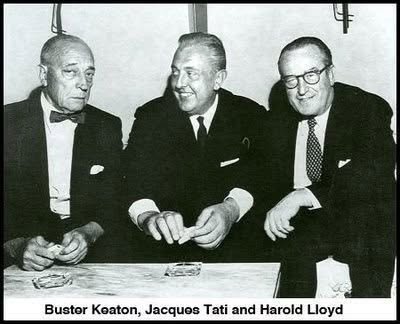
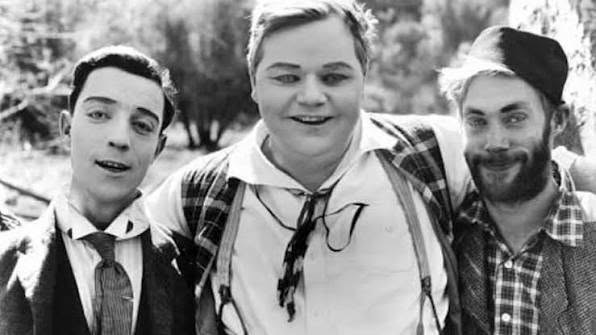
The image above is glorious. We should all know who Buster Keaton and Harold Lloyd are, but the one in the middle is a bit less known here in the US.
He made only nine films, six features and three shorts, but is considered one of the top fifty directors of all times. He produced, directed, and starred in an Academy Award wining film, Mon Oncle. His name is Jacques Tati.
What he has in common with the stars framing him in the photo is that he started his entertainment career in pantomime. Silent film was all pantomime. His films were made in France, with French speakers, but they are as close to silent as sound cinema gets. The gags are almost entirely visual, and you don’t need to hear the dialogue to understand the comedy.
This article is about the three greatest comedic actors of the silent era: Harold Lloyd, Charlie Chaplin, and Buster Keaton, how they faired, and what they brought to the world.
I’m going to start out with Harold Lloyd because I’m currently rediscovering him and learning some amazing things about his work, especially since his films are on the HBO/Max and Criterion Channel. And I’ve watched them all twice.
Harold Lloyd
Lloyd’s most iconic film is Safety Last. And here’s his most iconic photo (there are maybe 50 variations) of him hanging from that clock. People in the audience back then actually fainted from some of his stunts.
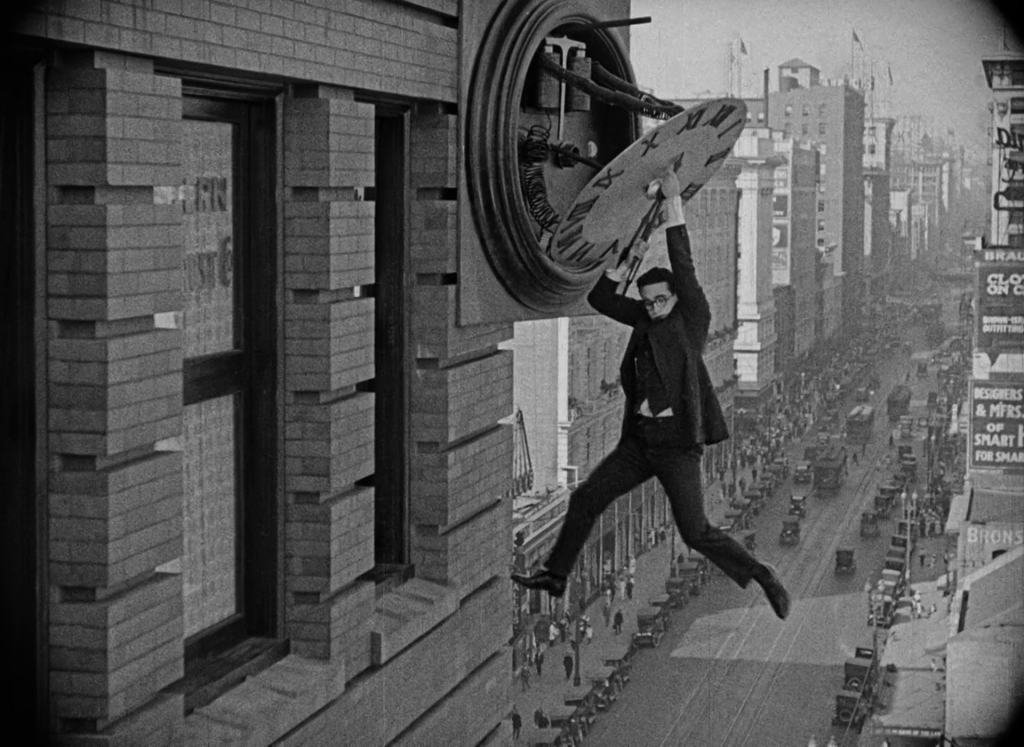
I have spent hours researching how they made this film because while watching it, I suddenly realized that the background kept changing as he climbed higher and higher.
I watch films with my phone opened to IMDB and a few AI agents (today), and I ask questions. My first question was about one of the buildings in the background, but all I could find was that it was a building in the background of this film. And that was before I got five AI apps on my phone.
How they made the film: they kept moving the set to the tops of buildings around Los Angeles, where they would build a structure on top of that building. Were Harold Lloyd to fall, he’d fall just ten feet to the top of the building. To make it safer, they laid out mattresses below him, but when they tested the mattresses with a dummy, the dummy hit the mattresses and rolled off the top of the building.
Watching Lloyd, it was easy to see that he was quite the athlete. What I didn’t know, and was shocked to learn, was that his right hand was slightly crippled, or partially maimed. He’d lost his thumb and index finger, and the remaining fingers were weakened but still usable. And he hung off that clock, hung onto ropes, and climbed about with that hand. So, let’s get into that first.
The Accident
On August 24, 1919, Lloyd visited the Albert Witzel Photography Studio in Los Angeles for a publicity-photo session. Lloyd had just signed a new contract with Pathé for a series of two‑reel comedies, and the studio wanted fresh portraits and publicity stills for magazine ads and posters.
During the session, the photographer handed Lloyd what everyone believed was a harmless prop bomb, a black sphere with a fuse, the kind used for comic photos. Lloyd clowned around, took the cigarette out of his mouth and lit the fuse, expecting a harmless puff of theatrical smoke. The fuse caught instantly, and produced a lot of smoke. Instinctively, he lowered the bomb away from his face, just moments before it exploded, blowing off his thumb and index finger and temporarily blinding him as the flash burned his eyes. Had he held it near his face, as the photographer had wanted, his career would have ended right there.
Lloyd experienced multiple surgeries and skin grafts, and long periods of physical therapy to regain partial use of his hand. He resumed limited work within a few months, but full production didn’t resume until the spring of 1920 with his first major film release after his convalescence, “Haunted Spooks” (March 1920) and that took nearly a year to finish because of his injuries.
For the rest of his career he wore a prosthetic glove and kept that hand out of close-ups. Lloyd was very careful about his image. If he pulled out a gun, he did it with his left hand. If his right hand needed a close-up, he used a hand double. And you’ll notice that when he’s climbing and hanging onto things, they filmed him from his left side. His flesh colored prosthetic glove looked convincing from a distance, and directors kept that distance by favoring angles showing is left side. It is truly astonishing, given the severity of the injury, that he returned to the same level of comedy and athleticism, climbing buildings, hanging from a clock, clinging to ropes, and doing everything he was famous for, with only partial use of his right hand.
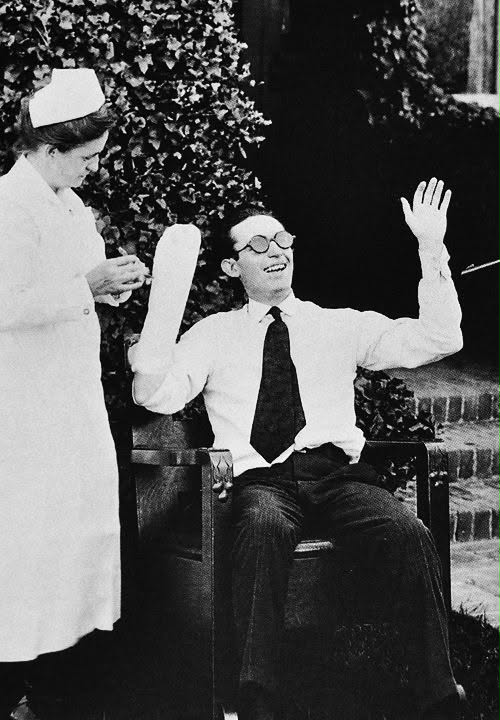
Then I recently caught something very strange. In his film, Haunted Spooks (1920), he shoots a squirt gun with his right hand. How does a person without an index finger shoot a squirt gun with his index finger? So, back to research!
Lloyd’s accident occurred while filming Haunted Spooks. The accident put the film on hold, and resumed in January the following year. Hal Roach took the parts, filmed before and after the accident and edited them together. So, he had both a working hand and a prosthetic hand in that film.
His Prosthetic Hand/Glove
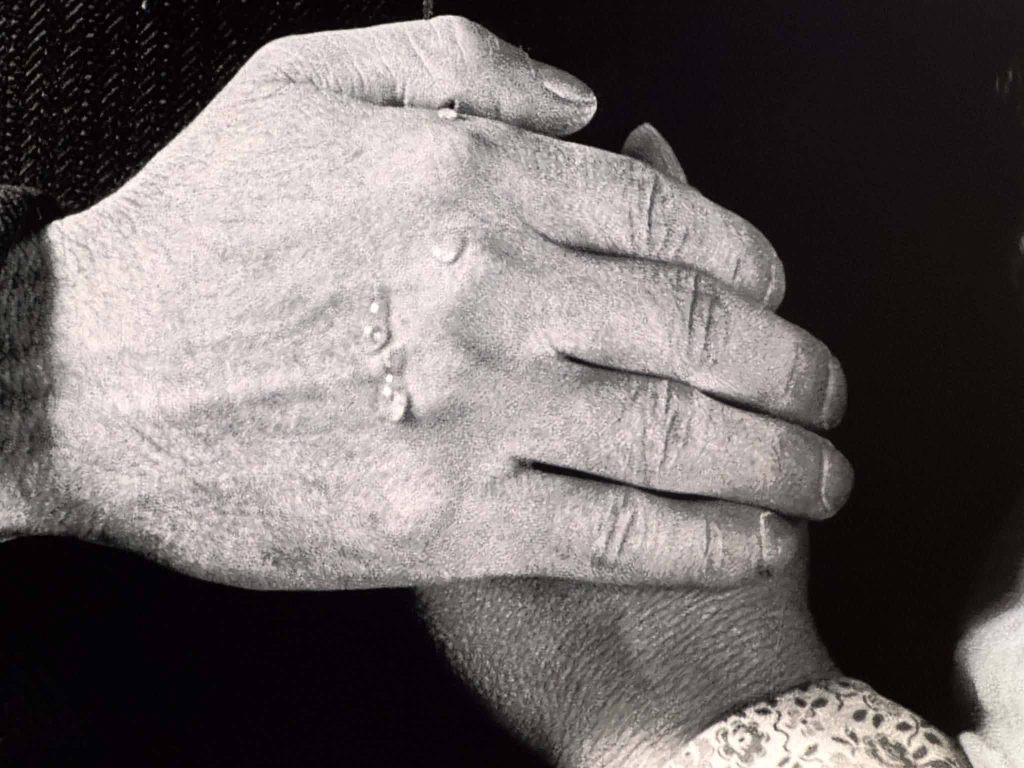
As I said above, he was very careful about his image. And for close-ups, he used a hand double.
In The Kid Brother, he holds the hand of his leading lady while she cries, and tears fall onto his hand. The close-up is his hand double.
Speaking of Doubles
One theme in literature is the doppelganger, or double. Remember The Prince and the Pauper?
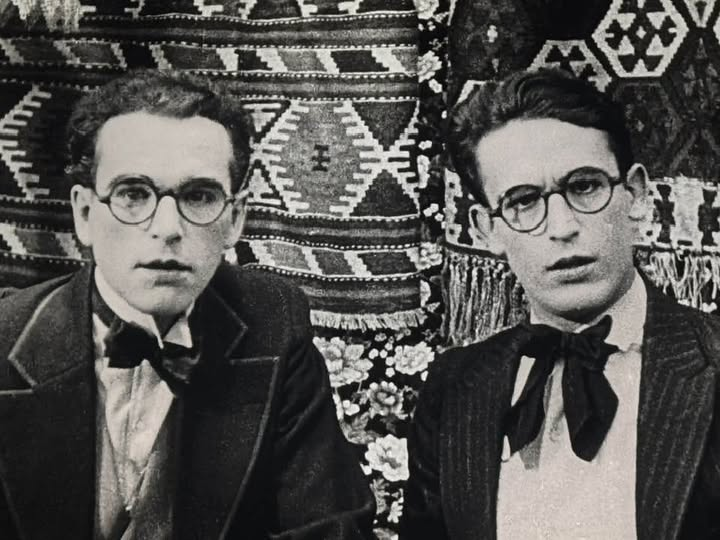
Harold Lloyd’s productions weren’t a family affair. But many in his family did dip into films, but briefly. His brother, Gaylord often doubled for him, and when you watch the credits, you’ll see Suzanne Lloyd Hayes is the key producer/archivist of the restorations and modern releases. His daughter appeared in The Cat’s Paw briefly, and his son, Harold Lloyd Jr became an actor in the fifties.
Gaylord appears in several films, is most visible in his Lonesome Luke period, and plays Harold’s doppelganger in just one film, His Royal Slyness.
Dragons
In medieval times, in medieval literature, there were dragons symbolizing overwhelming danger, chaotic power, the unknown, a force larger than the hero, and something that must be confronted and tamed.
In the twenties and thirties, modern life produced new dragons. The automobile was one. There is hardly a Laurel and Hardy film without a trick car. My favorite one is Busy Bodies (1933), where they drive through a bandsaw cutting the car in two.
Both Harold Lloyd and Buster Keaton realized modern dragons were machines, as did Chaplin in Modern Times. In The General, the train becomes a character, and Keaton must tame it. It’s not a prop, but the film’s central personality.
Lloyd was the first film star to turn an escalator and a revolving door into characters. Dragons, as it were. For silent films, technology replaced monsters, machinery replaced, myth, and the city replaced the forest.
His battle with the escalator is in High and Dizzy, and he gets a bag load of gags with a revolving door in Next Aisle Over.
Finding Their Personas — Lloyd, Chaplin, and Keaton
Charlie Chaplin wasn’t always The Tramp. And Harold Lloyd wasn’t always the Glasses guy. I mentioned above Lloyd’s “Lonesome Luke” phase. So let’s take a look.
Lonesome Luke, is basically a tall Chaplin, even his outfit looks Chaplin, and he’s all physical/slapstick comedy with no real central core. This was his first screen persona.
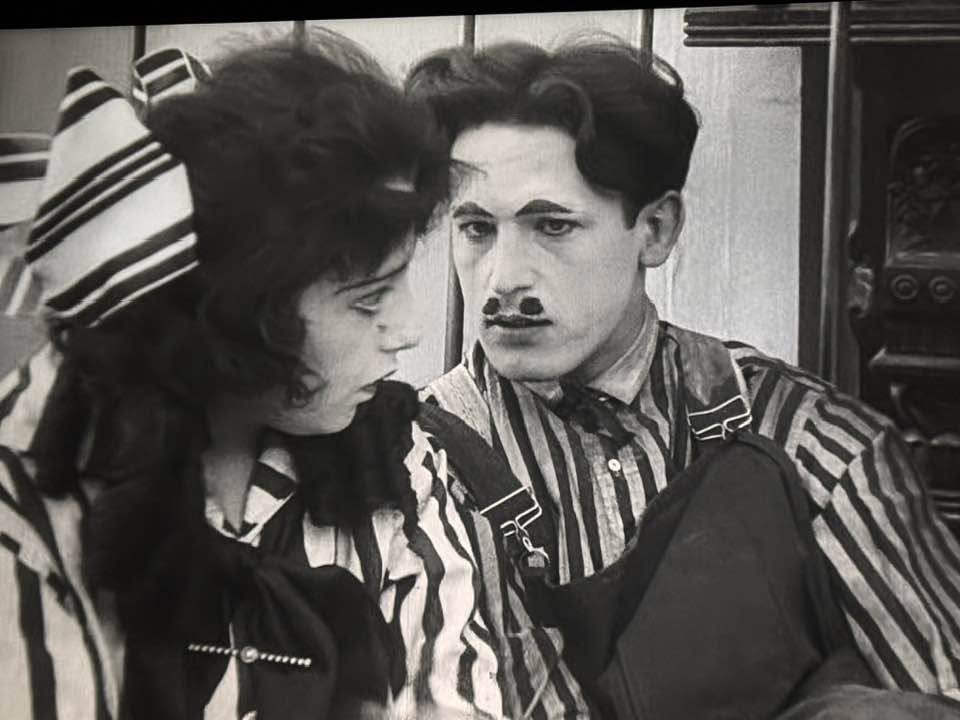
Luke was Lloyd’s pre-glasses guy, just as Chaplin had a pre-Tramp. Both learned the business, taking on roles, until they found their screen personas.
Luke was into broad slapstick, with no internal character logic, talented but still searching. He made 67 Lonesome Luke shorts for Hal Roach.
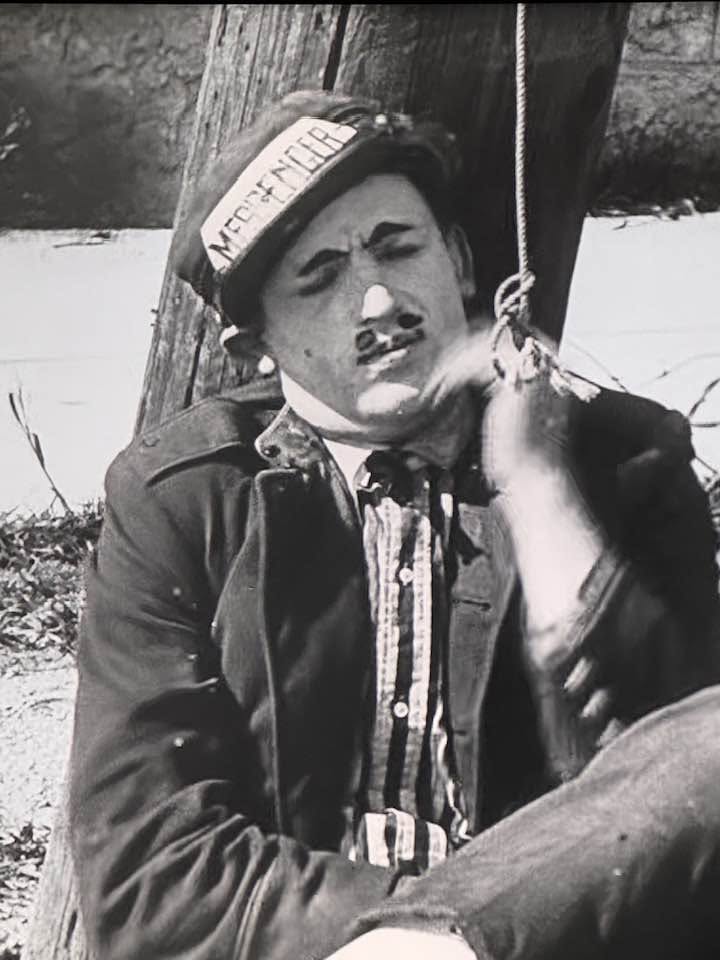
Chaplin, pre-Tramp, took Keystone stock roles: drunks, cops, villains; no bowler hat, no cane, and no “toothbrush” mustache. The one the Tramp and Oliver Hardy wore, until Hitler ruined it for everybody.
Even his signature walk hadn’t been developed yet.
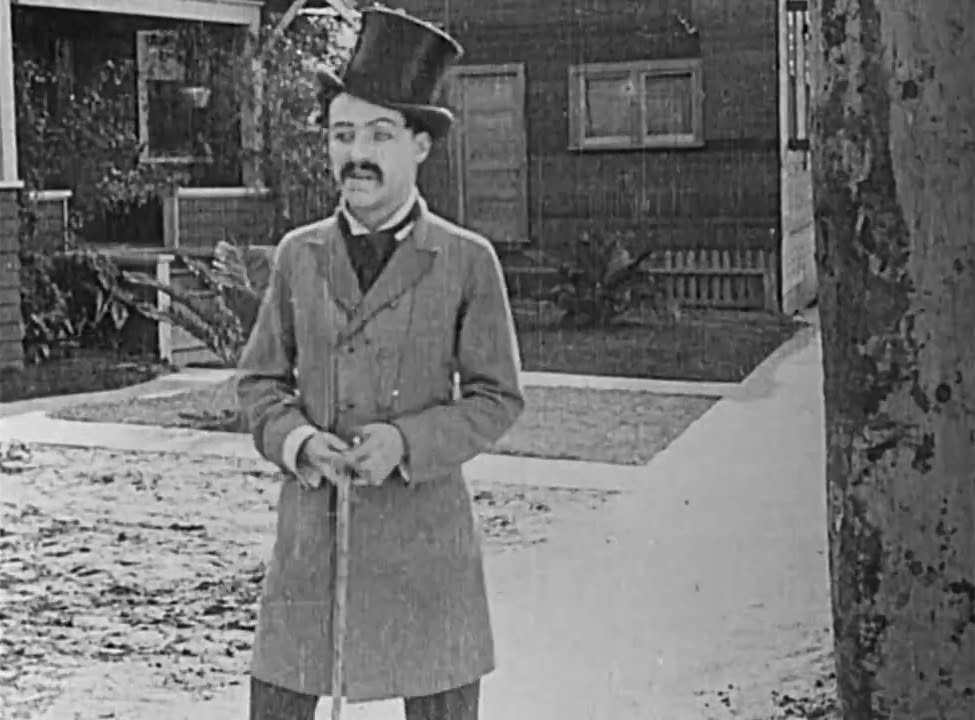
When Lloyd puts on his glasses (and even boxing and fighting they do not fall off), he becomes the modern American everyman (but still amazingly athletic).
When Chaplin assembled his Tramp costume in 1914, he becomes the world’s most recognizable comic soul.
Both men suddenly have a stable center of gravity and emotional depth.
But there was a third master of comedy at that time, and he was Buster Keaton.
Did you know Houdini gave him his name?
Joseph Frank Keaton (at about 18 months old) was touring with his parents in their vaudeville act, The Three Keatons. The father played a belligerent drunk, mom played straight, and little Joe was the human projectile, tossed, kicked, swung, slammed, and hurled across the stage.
Joe learned early on how to fall safely, and that was the foundation of his career.
During one performance, Little Joe took a spectacular fall down a flight of stairs, and stood up, deadpan, with no tears. Houdini, who was performing on the same bill, saw all this and said, “That’s a real buster!”
Buster was vaudeville slang for a fall, a pratfall, a wipeout, a crash landing.
And it stuck.
Buster didn’t develop a screen persona, he grew into one. Buster learned to bounce around with a deadpan face because if he smiled or cried, the gag died.
And he did it also out of survival. He did not want to provoke his father. Thus he learned acrobatic precision and timing, with a bit of mechanical curiosity as he developed the ability to treat props as living partners, as we see in The General.
So there you have the three greatest comic geniuses of the silent era:
Chaplin → spent a year at Keystone trying characters before the Tramp emerged
Lloyd → spent two years as Lonesome Luke before discovering the Glasses Character
Keaton → walked into films already Keaton
Comparing the Silent Giants: Popularity, Profit, and Public Response
By 1917, Charlie Chaplin had become the most famous film star in the world. He’d invented his persona of the Tramp in 1914, and within a year he was a cultural earthquake.
His mutual films (1916-17) earned record-breaking rentals. Often half a million dollars per film, which was unheard of for shorts. Exhibitors said Chaplin shorts were the most reliable money-makers in the industry.
His silhouette alone was a global icon, and he was earning $670,000/year, the highest salary in film history at that moment.
One the other hand, in 1917 Harold Lloyd was just finding himself. His Lonesome Luke character was popular, but just a Chaplin imitation. He released a large number of shorts for Hal Roach. They were solid earners, but only mid-tier box office. Roach’s studio depended heavily on Lloyd’s output.
Keaton just started in film in 1917. He worked with Fatty Arbuckle, and the films were good earners, but Keaton wasn’t yet the draw. He begins to learn film techniques and his rise starts in 1918 – 1920.
In the twenties, we see a bit of flipping, and then even more flipping.
In the early twenties, Chaplin is still the most famous comedian in the world. He’s releasing fewer films, but each is a massive event. “The Kid” and “The Gold Rush” are gigantic box-office hits. After the violent and sudden death of his close friend and his greatest villain, there was less slapstick, and more humanity. Chaplin’s work became more introspective, more artistic.
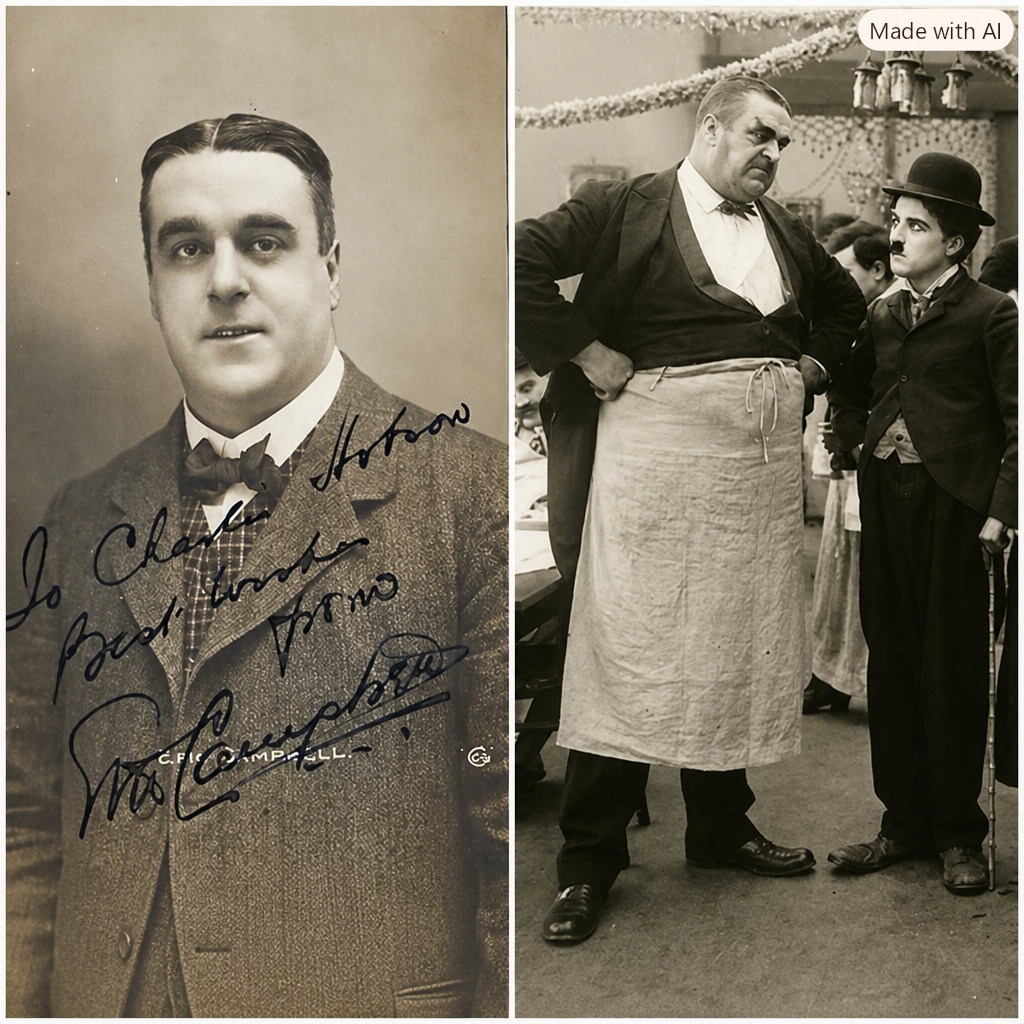
Mid to late twenties, Chaplin’s output slows. He releases only one film in the second half of the decade, “The Circus”. Still loved globally, just not top box-office draw.
In the mid to late twenties, Lloyd becomes the most consistent box-office star in comedy. Exhibitor polls rank him #1 because he’s releasing more films than Chaplin and all of them perform well. “The Freshman” becomes his biggest hit and the decade’s most profitable comedy.
Today we think “Safety Last” must have made him the most money, but it took decades for people to realize how great it was. In the twenties, it was a hit, just not his biggest hit. Years later we realize it’s a masterpiece and his most iconic film. Exhibitors and audiences loved Lloyd’s college films, his romantic comedies, and his “boy makes good” stories even more. Those brought in the money.
Keaton, at this time, was admired, but not a mass-market star. Today “The General” is recognized as pure genius, but at the time it was admired by some, misunderstood by many, and financially disappointing.
Then comes the thirties. Lloyd is riding high. Keaton is struggling, and Chaplin, well, that’s a whole nother story.
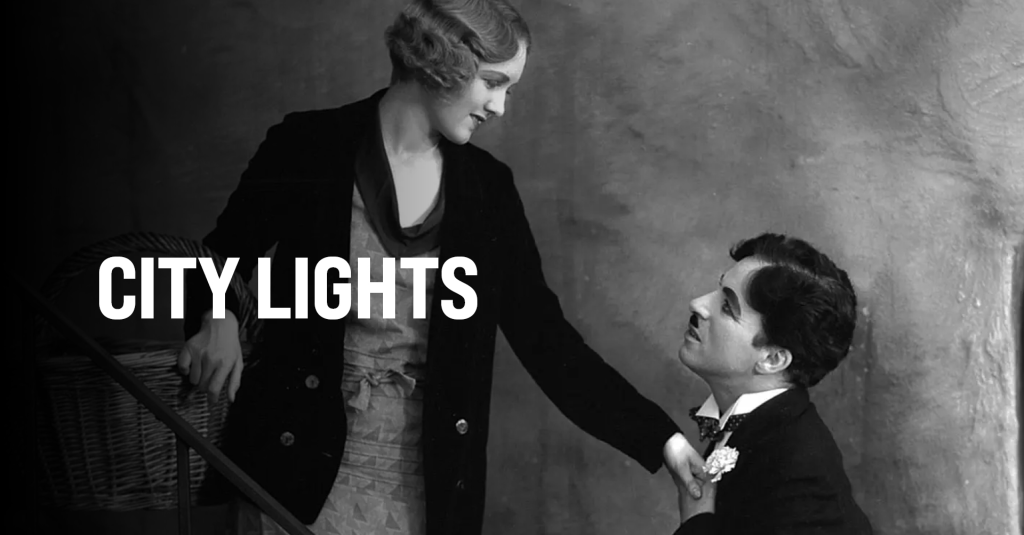
Chaplin no longer made films, he made art. He knew that sound would murder his Tramp. He started working on “City Lights” in 1928 and finished it in 1931.
When Hollywood began switching to talkies, Chaplin dug in and said no.
“City Lights” took, 190 days of shooting, over 2 years of productions, and hundreds (and hundreds!) of retakes. The flower-girl recognition scene? Shot over 300 times.
And poor Virginia Cherrill. He fired her, rehired her, fired her again, rehired her again.
And he composed all the music himself. And that extended production.
He knew he was battling an entire industry. He was terrified the Tramp was obsolete. He wanted this film to be perfect because it might be the Tramp’s last stand.
How Was it Received?
Many called it Chaplin’s greatest film and one of the biggest hits of 1931. People expected a relic, instead they got a masterpiece. Even Hollywood was stunned when a silent outgrossed many talkies.
Again, he wasn’t making films, he was making art.
Lloyd had been consistently beating Chaplin at the box office in the last five years of the silent era, and then boom . . . City Lights topped them all.
Critics wrote that Laurel and Hardy would never make a successful transition to sound. They said slapstick is dead. They said Chaplin was obsolete and would be left behind by technology.
They were wrong.
But still, it was Harold Lloyd and his comedy that made the smoothest and most profitable transition to sound. His early thirties work outgrossed Chaplin, but mainly because Chaplin wasn’t making movies. His early talkies: “Welcome Danger,” “Feet First,” and “Movie Crazy” were box-office gold. But the mid-thirties is where his decline began. Comedy had changed. Audiences wanted faster, louder, and more anarchic humor, like the Marx Brothers and their screwball comedies. And Lloyd’s persona aged. He was no longer a boy striving for success. This didn’t fit the man. Besides, he’d become one of Hollywood’s richest men. He didn’t need to work. Starting with “The Cat’s Paw” in 1934 we see a downhill slump to “The Sin of Harold Diddlebock” in 1947 which was a horrible flop.
Meanwhile, Buster Keaton had to fight for his life. In 1928 he signed a contract with MGM and basically they pushed him off a cliff. He’s no longer allowed to direct, write his own gags, and couldn’t even pick his stories. He’s forced into formula scripts, and is assigned directors who don’t understand his style. Instead of comedic actor, he’s now just a performer. His genius depended on total control, and he had none.
Today we see “The General” for its pure genius. The train becomes a character, a central character. The comedy is built from logic. Keaton doesn’t do “jokes.” He builds a cause and effect chain where ever action triggers another action, like a machine. This is comedy from precision and timing, not the chaos of slapstick. His “chase structure” is so perfectly timed that modern directors study it like scripture. And that final bridge collapse is still one of the most expensive and breathtaking stunts ever filmed.
It’s visual poetry.
Under MGM, that’s all gone. His marriage falls apart, he battles drinking, loses his studio contract, and MGM fires him. He ends up making cheap shorts for Educational Pictures (1934–1937). By 1939, he’s broke, drinking heavily, hardly working, and forgotten by the public. Hollywood considered him “washed up.”
While Lloyd is still a box-office force in the thirties, and Chaplin is finishing up “City Lights” and starting “Modern Times,” Keaton is fighting for survival.
In 1936 with the depression hitting us hard, Chaplin releases “Modern Times,” a half silent/half talkie, and it’s a hit, a major hit, a massive world-wide hit. Lloyd is rich, but not even competing at the box office. Chaplin proved he could still dominate without full sound. He’s reestablished himself as the king of comedy.
Then came the coup de grâce of his artistic transformation; the moment he stepped beyond comedy into global moral authority.
The Great Dictator (1940)
Chaplin’s biggest box‑office success of his entire career. This film reasserts Chaplin as the global king of comedy and political satire, grossing, world-wide, $5 million. In today’s dollars, that’s $120 million.
After 1940, Lloyd’s career is essentially over, while Chaplin enters his late‑period artistic phase.
And now comes the greatest redemptive story in the history of film.
Chaplin would make two more films, ”Monsieur Verdoux” in 1947, and “Limelight” in 1952. He’s slipped out of the role of comedian, and slipped into the role of a philosopher of cinema.
Chaplin hires Keaton for “Limelight.” Though forgotten by Hollywood and considered “washed up,” Chaplin personally invites Keaton to appear in “Limelight.”
Chaplin basically reintroduced Keaton to the industry, reminding critics of his brilliance, and gave Keaton a dignified, artistic platform. He insisted that Keaton be given full freedom to created his own gags, and later said, “Keaton was the greatest silent comedian.”
“Limelight” became the the spark of Keaton’s rediscovery. The French championed him, film scholars reexamined his work, retrospectives began, his films restored, and he becomes an honored elder statesman.
Keaton’s reputation rises from forgotten to genus. Chaplin didn’t just save Keaton, he opened the door at the exact moment Keaton needed it.
Their scene in “Limelight” is both a farewell to the silent era and a rebirth for Keaton.
Caution! Danger!
Yes, I could have ended this right here, but the most amazing aspect of silent comedies was the dangerous stunts they pulled off, both Lloyd and Keaton.
Lloyd performed stunts at actual height(no trick photography), no safety nets, and did it all with a prosthetic hand. He stood next to real trains, real cars, and if he goofed, he died. His danger was literal.
Keaton comes in a very close second. He performed stunts with precise physics, often one-take risks. The falling house facade in Steamboat Bill Jr is one of the most dangerous stunts ever filmed. Then there were his jumps from buildings, moving cars, and trains. He even broke his neck and didn’t realize it for years. His danger was mathematical. One calculation off, and he’s dead.
When Lloyd wasn’t up seven stories, he was performing stunts on the streets, many of which could have killed him.
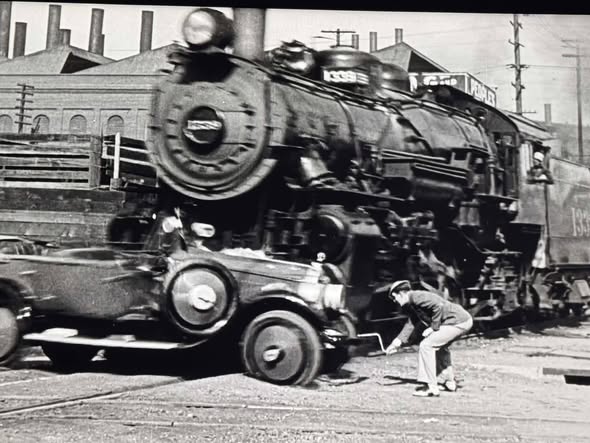
The film, For Heaven’s Sake has a few stunts on the ground that were just as dangerous as his stunts up in the air.
While at the hand-crank of his car stalled on the railroad tracks, with him just cranking away, a train comes along and takes out the car. Yes, the car was a prop car, hollow inside, with all the metal and glass removed. But there were no stunt standards and no ambulance on hand in case of an accident. I did learn that there was a car nearby just in case he had to be driven to the hospital.
This film ends with a run-away double decker bus, which is absolutely bizarre because those things could flip with a strong wind (hardly an exaggeration).
Here’s how they did it.
The bus was bolted onto a larger, heavier vehicle, creating the illusion of chaotic lurching, and the low center of gravity was stable. The rails were reinforced. Special braces on the railing for the rail-walking gag. And of course, the police controlled the streets.
And the run was rehearsed THREE TIMES.
1. first on a stationary bus, to learn positions and weight distribution.
2. slow-roll movement so that cast could practice rolling and coordinate their swaying.
3. full-speed run with camera truck alongside. The “dress rehearsal.”
And with all that, it was still genuinely dangerous, and everybody involved knew it. The rocking mechanism created real instability. There were 20+ performers on a moving platform, the bus was moving through real streets. And then there was Lloyd’s prosthetic hand.
Lloyd didn’t seek danger recklessly. He and his crew did everything possible to remove most of the danger, but he still put himself into situations where a mistake could kill him . . . or put him in the hospital for a long, long stay.
I found it on YouTube, so enjoy.