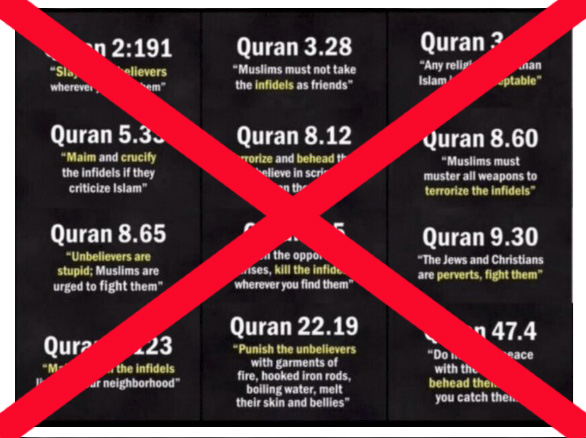

On 9-11 the internet was alit with screeds from islamophobes, many posting “quotations” from the Quran, except they weren’t from the Quran, were out of context, and designed to foster hatred toward Muslims.
For example, some of the quotations used the term “infidel” which isn’t in the Quran. The English word “infidel” is medieval, brought into use in the 15th century while the Quran was “revealed” in the 7th century. I say “revealed” because Muhammad, according to today’s language was “illiterate,” which is a modern oversimplification. Islamic tradition says Muhammad was “ummi,” often translated as “unlettered” It means he was not formally schooled and not trained in writing. In his day very, very few could read or write, but what came out of Mohammed’s mouth was brilliant and poetic, beyond the scribblings of any scribe. Even ancient non-Muslim scholars recognized the Quran to be rhetorically powerful and unprecedented, as well as poetically structured.
Al-Walid, one of Muhammad’s fiercest opponents; yet when asked to explain the Quran’s style, wrote: “By God, there is sweetness in his words, and a charm upon them; their upper part is fruitful, and their lower part is abundant. They rise above all and nothing rises above them.”
Al‑Akhṭal Christian Arab poet, was openly critical of Islam, but described the Quran as “a speech that has defeated all other speech.”
Modern, uninformed critics of the Quran, many who’ve never read a single verse, do not realize that Quran was created during a period that included war, and that the instructions given refer to wartime situations, not universal commands. This is how out of context “quotations” are spread in fear and hatred of Islam.
The image above contains . . . garbage. Nothing in it is true about the Quran. Call them out of context or call them lies, I’m about to go over every “passage” mentioned and correctly identify what the Quran said and what the Quran meant.
We will post first the passage/quotation from the meme, followed by a critique and the truth.
The Quran
2:191
“Stay the unbelievers wherever you find them.”
The actual (widely accepted translation) is this: “And kill them wherever you confront them and drive them out from where they drove you out.”
This refers to a specific historical war between Muslims and the Quraysh tribe in Mecca. It is not a general command to attack non-Muslims. Context can be grasped in the surrounding verses that explain how Muslims were being persecuted, tortured, and expelled from their homes. Muslims were permitted to fight only in self-defense. They were told to stop fighting if the enemy stopped and were forbidden from further aggression. Forbidden unless attacked.
Verse 2:192 says: “But if they cease, then there is to be no aggression except against the oppressors.”
3:28
“Muslims must not take infidels as friends.”
This is a mistranslation and misinterpretation. Again, the word “infidel” is not in the Quran.
The Arabic word “kāfirīn” does not mean “infidel.”
The verse is about wartime alliances, not friendships, and the instruction is: Do not take hostile enemies as political protectors over your own community. This is about security alliances and not personal friendships.
Elsewhere the Quran says explicitly, “God does not forbid you from being kind and just to those who do not fight you.”
3:85
“Any religion other than Islam is not acceptable.”
Another mistranslation. The original line is: “Whoever seeks a religion other than Islam, it will not be accepted.”
The irony here is every religion considers itself the final revelation. Why shouldn’t Islam?
Christianity tells us salvation is only through Christ, while Judaism has the covenant with Israel.
This is a doctrinal statement, and not a command to harm or reject anyone.
5:33
“Maim and crucify the infidels if they criticize Islam.”
Here is the actual line: “The punishment for those who wage war against God and His Messenger and spread corruption in the land is death, crucifixion, cutting off hands and feet on opposite sides, or exile.”
If only islamophobes understood crime and punishment.
This verse is not about ordinary unbelievers. It refers to violent criminals in early Islamic society; specifically bandits who murder, raid caravans, or destabilize the community. Commentary says that this particular passage was revealed after a group killed a shepherd and mutilated him. The verse talks of legal penalties for violent crime, and not a command toward non-Muslims.
8:12
“Terrorize and behead those who believe in scriptures other than the Quran.”
This is the accurate version: “I will cast terror into the hearts of those who disbelieve; so strike them.”
This passage actually describes a specific battlefield moment during the Battle of Badr, an early defensive war where Muslims were outnumbered and facing an attacking army.
It’s not a command to humans, but spoken to angels, and is part of a narrative passage, and not legal or moral instruction.
8:60
“Muslims must muster all weapons to terrorize the infidels.”
Again, a mistranslation and taken out of context. This is all about military readiness during a specific historical conflict. “Prepare against them whatever force and cavalry you can.”
And of course, the next line is left out: 8:61, “If they incline to peace, then incline to it.”
8:65
“Unbelievers are stupid; Muslims are urged to fight them.”
The actual line: “O Prophet, urge the believers to fight.”
This is a battlefield instruction specifically addressed to Muhammed during the Battle of Badr. Nothing more.
9:5
“When the opportunity arises, kill the infidels wherever you find them.?
Again with the “infidels.”
The actual verse: “Then when the sacred months have passed, kill the polytheists wherever you find them.”
This is not a general commandment, but refers to a specific treaty violation in the 7th century.
Here’s the full story: A group of tribes made a peace treaty with the early Muslim community, They then broke the treaty, attacked the Muslims, and killed many. 9:5 addresses those tribes, not non-Muslims, and it applies only after the four sacred months of truce. In 9:6 Muslims are commanded to protect and escort any non-Muslim who seeks safety.
9:30
“The Jews and Christians are perverts, fight them.”
This is an out and out lie. The actual line describes a theological claim, not violence. It criticizes specific religious doctrines, similar to how the Bible critiques pagan beliefs or how the Torah critiques idolatry: “The Jews say, ‘Ezra is the son of God,’ and the Christians say, ‘The Messiah is the son of God.’”
Nowhere in these passages are a command to harm anyone.
9:123
“Make war on the infidels living in your neighborhood.”
The actual line (taken way out of context): “O you who believe, fight those unbelievers who are near to you.”
Again this verse addresses a specific regional conflict in the late 7th century. It refers to hostile groups actively attacking the early Muslim community, not all non-Muslims.
22:19
“Punish the unbelievers with garments of fire, hooked iron rods, boiling water, melt their skin and bellies.”
This is my favorite because it is terrifying, and proof Islam is full of terrorists who want to do this to our children. Not.
Just a bit of insight: we have this in our own culture. Pastors preaching the throes of hell, eternal fire and brimstone where a sinners flesh never stops burning, forever and ever.
The misquotation isn’t even close to the Quran’s 22:19, which introduces a parable about two groups: “These are two adversaries who dispute about their Lord.”
They are:
- those who reject God
- those who believe
It’s part of a symbolic end of times story, about divine judgement. The Quran uses intense metaphors for Hell, similar to the Bible’s “lake of fire,” “weeping and gnashing of teeth,” “worms that never die,” and “eternal flame.” As for the garments of fire and boiling water, and their skin and insides melting? Those are in different parts of that chapter.
This is an Islamic description of Hell and not commands for all Muslims. Christians and Muslims both have this in common:
- Evil has consequences
- Justice will be done
- God sees what humans ignore
Both traditions separate divine punishment from human action, and neither tells believers to inflict these punishments, or imitate them, or even enact them on earth.
By the way, our modern, Christian descriptions of hell did not come out of the Bible, but from:
- Dante Alighieri — Inferno (1300s)
- Medieval Christian art (12th–15th centuries)
- John Milton — Paradise Lost (1600s)
- European folklore and drama
The Bible’s actual descriptions of hell are sparse and symbolic. There is no hell in the Old Testament, or as Howard Wolowitz said, “Jews don’t have hell. We have heartburn.”
47:4
“Do not seek peace with the infidels, behead them when you catch them.”
There is nothing in the Quran that is even close to this. Here is a the verse: “O you who believe, if you support God, He will support you and make your steps firm.”
Any treatment of non-believers in the Quran are battlefield orders. There are no universal commands about cruelty to non-believers, and specifically commands Muslims, after the war ends, to release prisoners either by grace or ransom.
This verse is motivational, commanding believers to stay committed, stay principled, and stay steady under pressure.
One Last Piece of Disinformation About Muslims.
Many people spread this about, that Muslims are permitted to lie to infidels.
First it is false. It comes from a misunderstanding of a narrow historical concept called taqiyya, which does not mean lying to non‑Muslims.
Taqiyya was a Shia doctrine allowing someone to hide their religious identity if they were about to be killed for it. It is not about Muslims lying to non‑Muslims. Islamic ethics strongly condemn lying except in a few universal human situations (e.g., saving a life, reconciling people, avoiding unjust harm).
Because the Quran is copyrighted, we weren’t able to publish full passages.
Fair Use
We are a 501 (c)(3) charitable organization.
The material on this site is provided for educational and informational purposes, as well as a bit of entertainment. Our focus is health and wellness, history, and educational subjects such as journalism, economics, and climate change. Though some of the material (much of which has been sent to us by readers), might be copyrighted, we have tried to link back to original sources. Much is believed to be public domain.
We believe this constitutes a “fair use” of copyrighted material as provided for in section 107, of the US Copyright Law. In accordance with Title 17 USC Section 107, the material on this site is distributed without profit to those who have an interest in using the included information for research and educational purposes. If you wish to use copyrighted material from this site for purposes of your own that go beyond “fair use,” you must obtain permission from the copyright owner. The information on this site does not constitute medical, legal, or technical advice.
Fair Use Definition
Fair use is a doctrine in United States copyright law that allows limited use of copyrighted material without requiring permission from the rights holders, such as commentary, criticism, news reporting, research, teaching or scholarship. It provides for the legal, non-licensed citation or incorporation of copyrighted material in another author’s work under a four-factor balancing test.
To read what we feel is one of the better translations of the Quran, click here: Quran