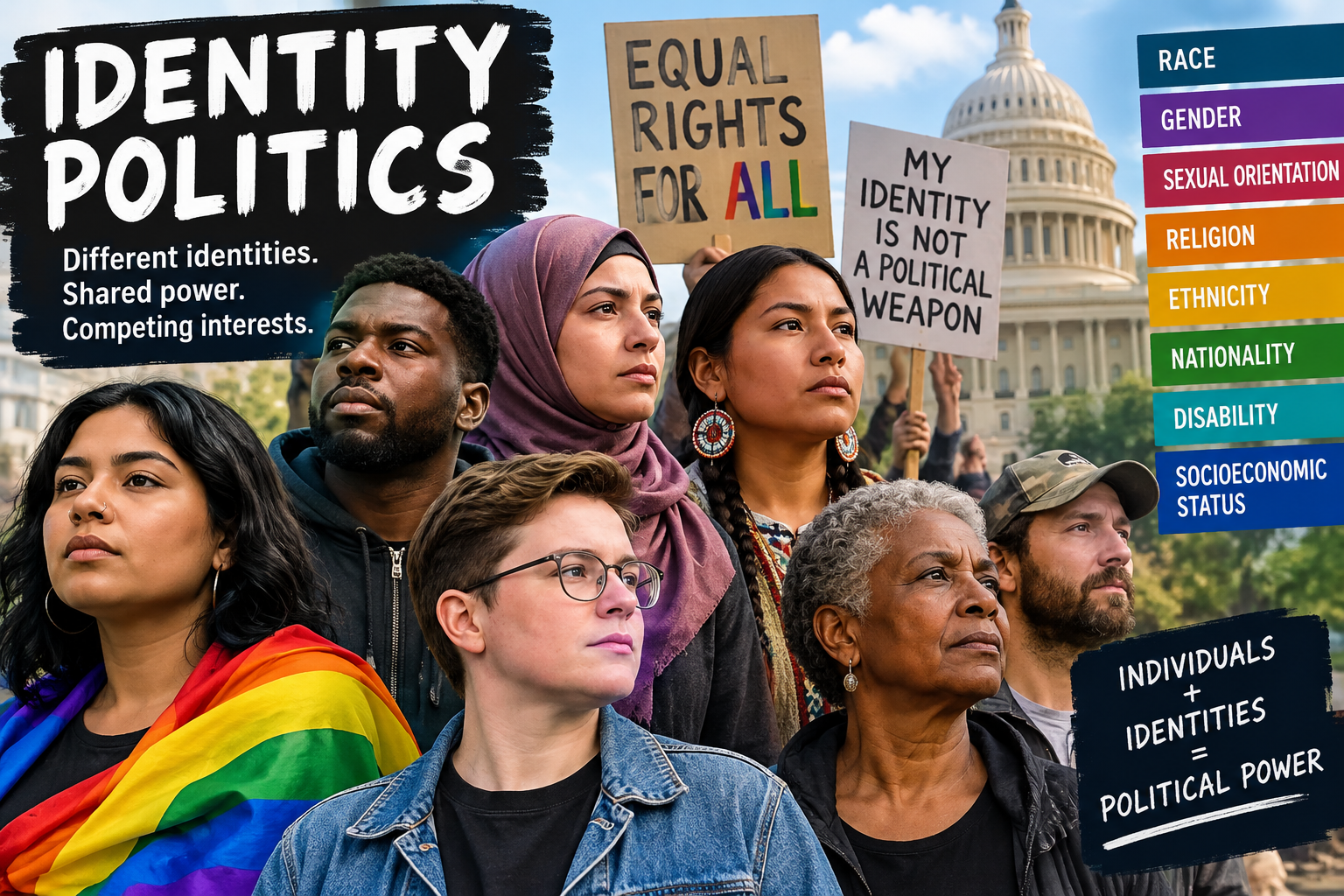

Definition: political actions, arguments, or movements that are organized around shared aspects of identity, such as race, gender, sexuality, religion, or ethnicity, rather than broader, universal interests. “Red states” and “blue states” can function as an identity group, a political identity. This is also referred to as political tribalism.
Liberals often claim that poor conservatives vote against their own self-interests, which is condescending and dismissive, but admits to a misunderstanding of what “self-interest” actually means.
A conservative friend once said to me that when a Democrat was in the White House, he made more money, but that he voted Republican for the sake of the country. Obviously he wasn’t voting his “wallet.”
When a Leader Becomes “Self”
In the psychology of identity politics, a leader can become fused with the group’s identity through a process called “identity fusion.” When this happens, the leader stops becoming a separate person and the group starts experiencing that person as an extension of themselves, a symbolic embodiment of “us.”
The leader comes to represent the group’s struggles, their history, or perhaps I should say their imagined history, their mythology. The leader is the group’s hopes for a better future, an answer to their grievances, and most of all their sense of pride.
Attacks on the leader are attacks on their own existence. And suddenly there’s moral inversion.
Moral Inversion
Identity politics creates an “us vs. them” worldview, so strong that actions normally seen as immoral become redefined as moral when done in the service of the group.
Right becomes wrong; wrong becomes right; up is down, down is up, and it can become violent.
Nazism is one of the clearest examples in modern history.
Compassion (empathy) was reframed as weakness and cruelty was reframed as strength. The dehumanization of Jews, disabled, intellectuals was reframed as not only acceptable, but morally imperative.
Obedience replaces conscience. The individual’s moral compass was replaced by loyalty to the Führer. Good and evils were now obedience and dissent.
Violence became purification. Mass violence was presented as a way to cleanse and protect the nation. Genocide was framed as an hygienic act.
Finally: Lies Become Truth
In Nazi Germany, propaganda replaced reality. Facts were treated as threats. Myth became the more center of the state, and suddenly the victim became a threat.
German civilians knew about persecution, deportations, camps, and brutality. They did not know, or did not allow themselves to know, the full machinery of extermination.
Group identity filters reality. German citizens knew Jews were disappearing, that their businesses were shuttered, their homes empty. They saw prisoners. They heard rumors. But when national identity becomes sacred, information that threatens the group’s self-image gets minimized and rationalized, and the group lives in a permanent state of denial.
Here in the USofA
There’s a phenomenon known as the Boomerang Effect. This is when someone inside a group is confronted with facts that contradict the group’s beliefs, they often react by believing their original position even more strongly.
We saw this in the South when people were told how good Obamacare was. Many disregarded it and believed it would take away freedom, destroy local healthcare, and bankrupt the country. Interestingly enough, if asked about the ACA (Affordable Care Act, which was nicknamed Obamacare), those same people praised it. They loved the ACA; hated Obamacare.
This is one of the most fascinating and well documented examples of identity politics.
Rallies
Hitler’s rallies were massive, choreographed spectacles designed to fuse individual identity into a collective national identity, making the leader and the nation feel like the same “self.”
All presidents have had their little rallies on the South Lawn. These were events that blurred the line between official ceremony and political rally.
But no president has ever held anywhere near as many rallies as our current president. He held 83 rallies in 2020.
And rallies reaffirm “belonging.” There’s group euphoria when cheering loudly together.
When it comes to lying, and propaganda, and the truth, identity politics distorts everything and an adhesive group will believe whatever doesn’t attack the group.
After the $787.5 million lawsuit Fox News lost against Dominion for lying (defamation), still, many viewers did not update their beliefs. To them Fox never lied. Identity is stronger then information. Their Fox network is part of their identity. It’s on their side, giving out their voice, their worldview.
The lawsuit was an attack by a crooked system.
The best‑documented count of Trump’s false or misleading claims during his first term is 30,573.
The group identifying with this president are in two camps.
Believing that number is a direct threat to their identity, thus they deny it, attack the source, reject the premise entirely. And then there are those who said, “So what?” And this last group see him as a fighter, a disruptor, and someone who speaks for us. His lies aren’t lies, their exaggeration, negotiation tactics, rhetorical flourish, and he says what others won’t. I’ve often heard people say, “He sure says what’s on his mind.”
And then there’s the violence. Violence is only the answer when morality flips.
As a veteran of Vietnam, I’ve come to hate war and violence, whether it’s across an ocean or on our streets . . . or at our Capitol. We’ve just celebrated our 250th anniversary and sadly, in all that time, we’ve had about 30 years of peace.
There must be a better way.
This is Our Shared History
As an educational charity, I believe we must all know our history in order to stop repeating what doesn’t work, what doesn’t help us, and strive for a better way.
And it’s all very simple, except for one thing.
We must learn to work together. Just like we did in post-WWII America, when we cooperated broadly, across institutions, classes, and regions. With the GI Bill, strong unions, and domestic manufacturing we got rising wages, stable jobs, and the strongest middle class in the world. We trusted institutions, government, science, media, universities, and each other. It was a “we” era and not a “me” era.
Another Type of Group Identity
Believe it or not, there is a group identity growing in the world of compassion, empathy, and oneness. The group defines itself by care, truthfulness, and shared humanity, and instead of being a weapon against other groups, it stands as a moral anchor. Instead of “us vs. them,” their identity reaches out to protect the vulnerable, to see ourselves in others, and to tell the truth, even if it hurts.
“Ah yes, truth. Funny how everyone is always asking for it but when they get it they don’t believe it because it’s not the truth they want to hear.”
Helena Cassadine
As a journalist, I know that most of the time, truth isn’t something you receive. It’s something you chase.
And the one truth history is consistently revealing is that only working together and caring about each other from every walk of life is what creates a better world for all.
There’s a great image of a rising tide lifting all boats.
We just have to be part of that tide.